

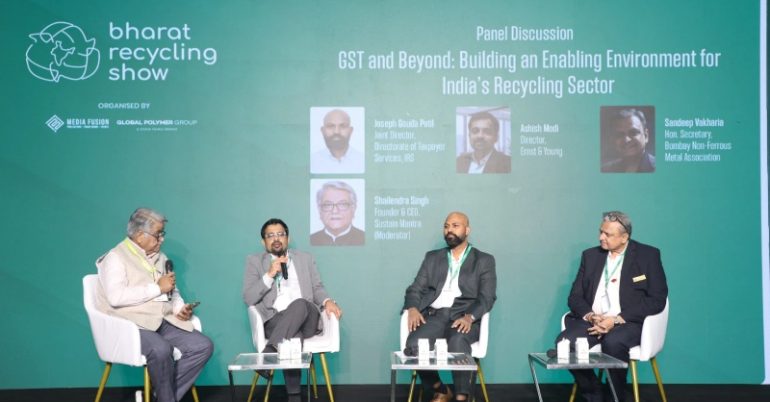
India’s circular economy transition hinges not only on technology and market maturity but also on the regulatory environment that shapes how waste materials move through the value chain. A recent panel discussion titled “GST and Beyond – Enabling a Circular Economy for India” brought together industry experts, tax specialists, and recyclers to examine one of the most persistent challenges in the sector: formalising a deeply informal waste ecosystem while ensuring that taxation frameworks like GST do not unintentionally hinder recycling.
The session opened with Joseph Gouda Patil, Joint Director at the Directorate of Taxpayer Services (IRS), who emphasised that India’s recycling and resource-recovery sectors are entering a period of structural change. He underscored the importance of regulatory stability and transparent tax administration in enabling responsible growth. “Policy stability and efficient tax administration create the confidence that industries need to invest, innovate, and expand. Our goal is to make compliance simpler while strengthening trust between taxpayers and the government,” he said, noting that policy clarity is especially crucial for sectors heavily dependent on informal suppliers.
The GST Paradox in Recycling
The discussion moved into a fundamental structural challenge: GST compliance is designed for formal, traceable transactions, whereas India’s waste ecosystem is largely informal and cash-driven. Ragpickers, aggregators, and small scrap dealers—who form the backbone of India’s recycling supply—often operate below the GST threshold.
When these informal suppliers sell material to formal recyclers, the first invoice becomes a point of vulnerability. If the aggregator does not charge GST or file returns, the liability often shifts to the recycler, who may later face questions from authorities regarding input tax credit (ITC).
Panelists reiterated that under Section 16(2) of the GST Act, recyclers can be denied ITC if the supplier has not uploaded proper documentation—even when the recycler has paid GST correctly and in good faith. For an industry heavily dependent on small-scale aggregators, this creates financial and operational uncertainty.
Why Reverse Charge Mechanisms Can’t Fully Solve It
Some argued that treating scrap procurement under a reverse-charge mechanism (RCM) appears, on paper, to offer relief. However, the practical realities are more complex. Aggregators commonly buy scrap in cash and resell it with a small margin of ₹50–₹80 per kg. If GST is applied at 18%, this margin becomes unviable, effectively pushing small traders out of business.
One panelist noted that “the informal sector is already incentivised not to come under GST. The cost structure simply does not support it.”
Formalising Without Disrupting Livelihoods
A recurring theme was the need to formalise the informal segment without dismantling it. India’s waste workforce—often women, migrant labourers, and low-income communities—forms the most critical layer of the value chain. Formalisation, the panel stressed, must be enabling rather than punitive.
They highlighted the need for low-friction registration processes, easy-to-use digital tools that do not require literacy or infrastructure, and simple documentation mechanisms that enable payment visibility without imposing unsustainable tax burdens. Unless payments between households, collectors, and aggregators are traceable, policymakers cannot design effective incentives.
Adding the consulting viewpoint, Ashish Modi, Director at Ernst & Young, said that long-term success requires a blend of compliance-friendly regulation and future-ready business practices. He observed that the growing demand for recycled materials from renewable energy, EVs, and modern manufacturing sectors makes structural reform urgent. “Companies that integrate sustainability, digital intelligence, and circularity into their business models will emerge as long-term winners,” he remarked, noting that the recycling industry must prepare for a rapidly evolving market landscape.
EPR as a Lever for Circularity
The conversation then moved to Extended Producer Responsibility (EPR), which participants described as a potentially powerful mechanism—if structured with the right priorities.
EPR shifts responsibility to producers for post-consumer waste and creates financial incentives to collect waste that would otherwise leak into the environment. However, recyclers pointed out that today EPR incentives often benefit recyclers but overlook collectors, even though true value creation begins at the point of collection.
One expert stressed that “the aggregator is the real value creator. If you don’t incentivise collection, the entire chain weakens.” Several panelists argued that EPR needs to flow to the earliest point of intervention—the moment waste is picked up from households or businesses.
From an industry perspective, Sandeep Vakharia, Hon. Secretary of the Bombay Non-Ferrous Metal Association, echoed the importance of strengthening the earliest steps in the value chain. He noted that the sector has long thrived on agility but now requires systemic support. “Our industry has survived and grown because of its agility. The next phase of growth will depend on stronger partnerships, better quality standards, and robust recycling networks,” he said, highlighting the need for incentives and traceability tools that enable small collectors and aggregators to participate meaningfully.
Why Traceability Matters
Speakers emphasised that a traceable and verifiable flow of material is essential for GST compliance and circularity. Without traceability, recyclers struggle to prove legality of inputs, authorities challenge ITC claims years later, producers cannot validate EPR fulfilment, and informal ecosystems remain invisible.
A key recommendation was the creation of a simple transaction-recording interface—not a change in law—that documents waste movement without forcing informal actors into the complexities of GST.
Beyond GST: What More Can Encourage Recycling?
As the discussion broadened, panelists identified several gaps and opportunities in India’s enabling ecosystem. Recycling is capital-intensive, and while schemes like EPCG offer some relief, they are insufficient. The need for dedicated recycling parks, low-cost industrial land, and shared infrastructure for effluents and waste handling was emphasised.
There was also strong support for reduced GST rates on recycled-content products, which would create market pull for circular materials. Recyclers also highlighted the need for harmonised state-level policies, with one speaker noting that “even officials are sometimes confused about what support is available.”
Bringing the thematic threads together, moderator Shailendra Singh, Founder & CEO of Sustain Mantra, reminded the audience that circularity must be viewed as a guiding principle rather than a technical adjustment. “Circularity is no longer a concept; it is a necessity,” he observed, noting that India’s recycling ecosystem can expand only if supported by clear policy, robust traceability, and respect for the informal sector’s contributions.
A 10% Opportunity for India
He further highlighted that India’s informal economy represents nearly 10% of the nation’s GDP, with waste management forming a meaningful portion of that. Formalising this sector could unlock millions of secure livelihoods, raise material recovery rates, strengthen the domestic recycling industry, create cleaner cities, and improve EPR accountability.
GST, the session concluded, is only one piece of the larger puzzle. Building a circular economy for India will require an ecosystem that balances smart regulation, financial incentives, technological integration, and dignified inclusion of informal workers. Only then can India achieve a truly circular and equitable waste economy.
Leave A Comment